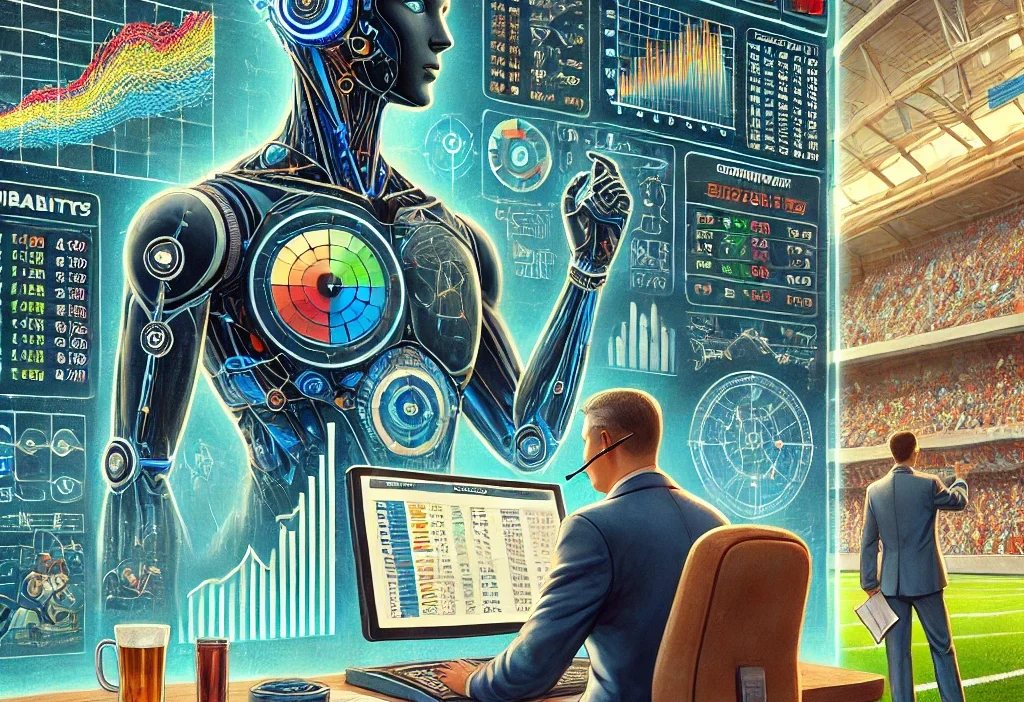
Recent studies suggest that machine learning models might be able to predict football game results better than bookmakers, but the results are mixed. Some researchers have used advanced techniques like deep neural networks and random forests, which analyze historical data, player stats, and in-game events to find value bets (Stübinger & Knoll, 2018; Stübinger et al., 2019; Tammouch et al., 2024). These models have sometimes produced significant profits (Barbosa da Costa et al., 2021; Hubáček, 2017).
However, as betting markets get more efficient, it is becoming harder to consistently beat bookmakers (Mangold & Stübinger, 2020). While some studies have found that machine learning can outperform bookmakers in certain cases, others have shown that these models still struggle to match bookmaker accuracy.
One major challenge is that bookmakers adjust their odds based on new information and bettor behavior. This makes it difficult for machine learning models to maintain an edge for long periods. As a result, researchers are focusing on adaptive models that can update their strategies in real-time (Galekwa et al., 2024).
Overall, while machine learning has shown potential in sports betting, it is not a guaranteed way to beat the bookmakers, and the betting market continues to evolve to reduce any long-term advantages.
One major challenge is that bookmakers adjust their odds based on new information and bettor behavior. This makes it difficult for machine learning models to maintain an edge for long periods
Summary of: Galekwa Et Al 2024
Anecdote
Have a story to share? Write to us at research@bettingresearch.org if you have a related, personal experience you would like to see placed here and share with the community.
Articles Cited
- “B. Mangold, Johannes Stübinger (2020): Investigating inefficiencies of bookmaker odds in football using machine learning, https://doi.org/10.4995/carma2020.2020.11619
- The paper investigates the efficiency of bookmaker odds in football by using machine learning models to predict match outcomes and systematically outperform the market, finding that this was possible in earlier years but has become increasingly difficult over time as bookmakers have improved their own modeling techniques and data processing capabilities.”
- “Johannes Stübinger, Julian Knoll (2018): Beat the Bookmaker – Winning Football Bets with Machine Learning (Best Application Paper), https://doi.org/10.1007/978-3-030-04191-5_21
- The authors developed a data-driven framework using machine learning on large datasets to predict football match outcomes and generate profits from betting, which outperformed simpler models and strategies.”
- “Igor Barbosa da Costa, L. Marinho, Carlos Eduardo S. Pires (2021): Forecasting football results and exploiting betting markets: The case of “both teams to score”, https://doi.org/10.1016/j.ijforecast.2021.06.008
- The paper investigates the predictability of the “”both teams to score”” (BTTS) outcome in football matches using machine learning models, and whether such models can outperform bookmakers and lead to profitable betting strategies.”
- “Johannes Stübinger, B. Mangold, Julian Knoll (2019): Machine Learning in Football Betting: Prediction of Match Results Based on Player Characteristics, https://doi.org/10.3390/app10010046
- The paper presents a machine learning framework for forecasting football match results and achieving excess returns through betting, using a large dataset of player characteristics and skills as well as betting odds data.”
- “Bc. Ondřej Hubáček (2017): Exploiting betting market inefficiencies with machine learning, –
- The authors used machine learning techniques, including a novel approach using convolutional neural networks, to develop models that could profit from betting markets by decorrelating their predictions from bookmakers’ while maintaining reasonable accuracy, and their models were able to achieve positive profits over 15 NBA seasons.”
- “Ilyas Tammouch, Abdelamine Elouafi, Ibtissam Essadik (2024): Betting on Machine Learning: Extracting Patterns from Football’s Anarchic Odds, https://doi.org/10.1109/CommNet63022.2024.10793344
- This study investigates the use of machine learning algorithms to predict football match results based on historical performance metrics, with a focus on feature selection and dimensionality reduction techniques to enhance model accuracy, and contributes to the growing field of sports analytics.”
- “Ren’e Manass’e Galekwa, Jean Marie Tshimula, E. Tajeuna, Kyandoghere Kyamakya (2024): A Systematic Review of Machine Learning in Sports Betting: Techniques, Challenges, and Future Directions, https://doi.org/10.48550/arXiv.2410.21484
- This paper provides a systematic review of the various machine learning techniques used in the sports betting industry, including their applications, challenges, and future research directions.”
Insufficient Detail?
At times it is difficult to answer the question as there are not enough relevant published journal articles to relate. It could be that the topic is niche, there’s a significant edge (and researchers prefer not to publish), there is no edge or simply no one has thought to investigate.